
Reading History: "Cleopatra"
Saara El-Arifi's new novel is a beautiful, haunting, and powerful story in which the ancient queen finally takes control of her own narrative.

Hello, dear reader! Do you like what you read here at Omnivorous? Do you like reading fun but insightful takes on all things pop culture? Do you like supporting indie writers? If so, then please consider becoming a subscriber and get the newsletter delivered straight to your inbox. There are a number of paid options, but you can also sign up for free! Every little bit helps. Thanks for reading and now, on with the show!
Warning: Full spoilers for the book follow.
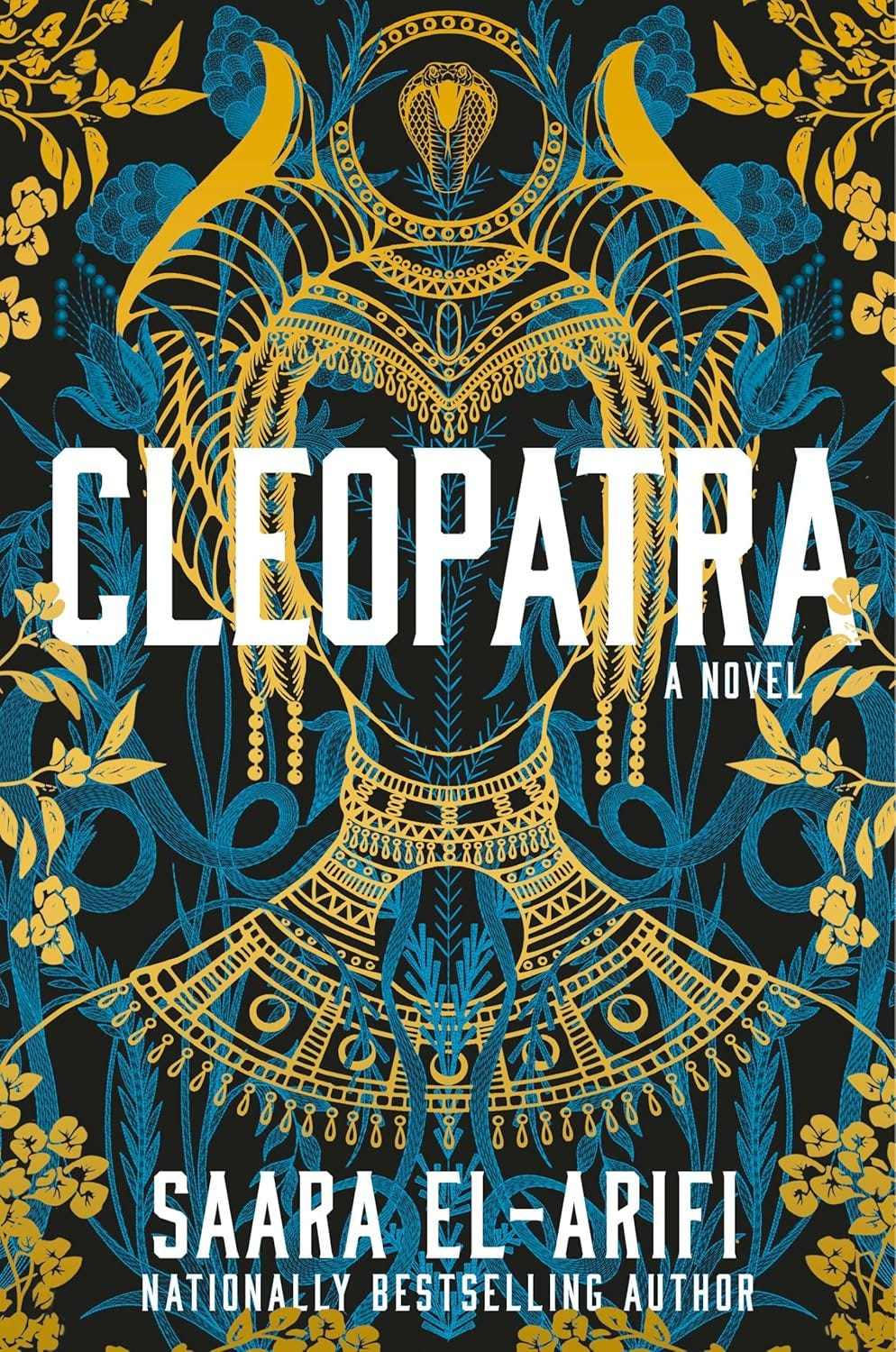
As regular readers of this newsletter know, I’m a sucker for a book about the ancient world, and if it happens to be about Cleopatra, arguably antiquity’s most formidable female ruler, then I’m going to be all-in. Imagine my delight when I saw Saara El-Arifi’s Cleopatra sitting on my library’s new release shelf. Given the subject and the absolutely gorgeous cover, I knew I was going to devour this book and enjoy every page.
Reader, I was not disappointed.
Framed as Cleopatra’s posthumous memories and recollections, the book does at times play a bit fast and loose with the historical record as we have it. However, this isn’t a failing but instead a reflection and an interrogation of just how much the last Ptolemy’s legacy has been twisted and filtered through the biases and animosity of the various (male) historians who have sought to tell her story to suit their own ideological agendas.
What’s especially refreshing about this version of Cleopatra’s story is just how unapologetic she is. Is this formidable woman capable of some truly heinous actions? Oh yes, you bet. She walks through the world with a ruthless streak, particularly when it comes to members of her own family. But, then again, when you’re a member of one of Egypt’s most notoriously unstable and fratricidal dynasties, you have to have a clear head about the risks involved. This is particularly true when it comes to her sister, Arsinoe, who proves to be one of Cleopatra’s most indefatigable enemies.
While Cleopatra isn’t afraid to deal out death when she has to, it’s clear just how much of a toll this takes on her heart and her soul. When, for example, she asks Antony to kill Arsinoe, she only does so with the greatest reluctance, and it really does break her heart to take this step. At the same time, we can’t help but be aware that she truly had no other choice in the matter. If she hadn’t taken this step, if she hadn’t been willing to do what was required, it’s entirely likely she would’ve ended up like her siblings, i.e. dead. Death, though, always comes with a terrible cost, whether it’s the agony of knowing Arsinoe is dead or the uncertainty of what happens to her brother when he is pushed into the Nile (by the very same Arsinoe!), condemned to a living death since he can’t die by drowning.
Some reviewers have taken issue with the inclusion of some fantastical elements, but I found these actually worked quite well. Unlike the rest of her royal family, Cleopatra hasn’t been blessed with an outward manifestation of a god’s (or goddess’) blessing, which means her rule is always inherently unstable. More to the point, because she doesn’t have this blessing, she repeatedly has to prove her own fitness to be queen. Moreover, as the last few chapters show, the blessing is itself a curse, a nice little twist that adds an extra layer of pathos to Cleopatra’s story and her eventual fate.
Of course, no book about Cleopatra’s reign could hope to be complete without delving into her relationships with Caesar and then Antony, two of the most powerful men of Rome. Her meeting with Caesar is cleverly executed, showing how the age-old story of her being presented in a rolled-up carpet is a misunderstanding of what happened. It becomes clear that theirs is truly a meeting of great minds, and they are poised to bring the world to heel, at least until Caesar’s assassination.
To me, Cleopatra’s relationship with Antony has more emotional depth. From the moment the two of them meet in a temple to Dionysos, it’s clear there’s a bond there, one that will bring the Mediterranean world to its knees. At the same time, however, it’s clear this is the kind of love and desire that could easily destroy them and everything they hold dear. The power of El-Arifi’s prose, however, lies in her ability to convince us that things might be otherwise, that somehow these devoted and passionate lovers might survive the dreadful fate that awaits them at the end of the story. While Antony gains the peace of death, Cleopatra is sentenced to eternal life thanks to Isis and, because she can never truly die, she has to live with the knowledge of how her life and story are twisted beyond all recognition. This revelation is a powerful way to end the novel, and it reminds us of how often women have to life with the fact that their stories are often not their own to tell.
As important as Antony and Caesar are to Cleopatra, however, it’s really her companion Charmian who is the most important person in her life (other than her children, obviously). Theirs is a bond forged in the world of the Egyptian court, and I think it’s safe to say the two of them are essentially two halves of the same soul. There is, quite simply, nothing that will ever truly sunder them from one another. No matter what happens, and no matter how many setbacks Cleopatra faces, she knows she can always count on Charmian.
Now, I will say that this book does feel a bit rushed at times, and I wouldn’t have minded getting to spend more time learning about Cleopatra and her world. El-Arifi has a knack for crafting beautiful descriptions, but she does tend to jump forward in time, glossing over large (and often significant) parts of her subject’s life. At the same time, I do like that we got more insight into Cleopatra’s personal life, rather than simply all of the politics that tend to take up so many other Cleopatra narratives.
Ultimately, I really did love how this novel is framed as a powerful “fuck you” to the historical record that has repeatedly framed Cleopatra as nothing more than a nymphomaniac who seduced men with her wiles and led them to her destruction. Thanks to El-Arifi’s skilled prose and her adeptness at teasing out the many complexities of her subject, I’m sure this novel will join others, including Margaret George’s magisterial The Memoirs of Cleopatra, which is just about the highest praise I can give.
As a way of concluding, I just want to note that I particularly loved the way El-Arifi characterized Cleopatra’s daughter, Cleopatra Selene, who is framed here as a badass warrior-in-training, someone who wants to fight rather than just accept the fate that’s been offered. I can think of no better way of cementing Cleopatra’s legacy.