
Book Review: "Wolf Worm"
T. Kingfisher delivers another unsettling and grotesque novel that's equal parts Southern Gothic, horror, and historical fiction.

Hello, dear reader! Do you like what you read here at Omnivorous? Do you like reading fun but insightful takes on all things pop culture? Do you like supporting indie writers? If so, then please consider becoming a subscriber and get the newsletter delivered straight to your inbox. There are a number of paid options, but you can also sign up for free! Every little bit helps. Thanks for reading and now, on with the show!
Warning: Full spoilers for the book follow.
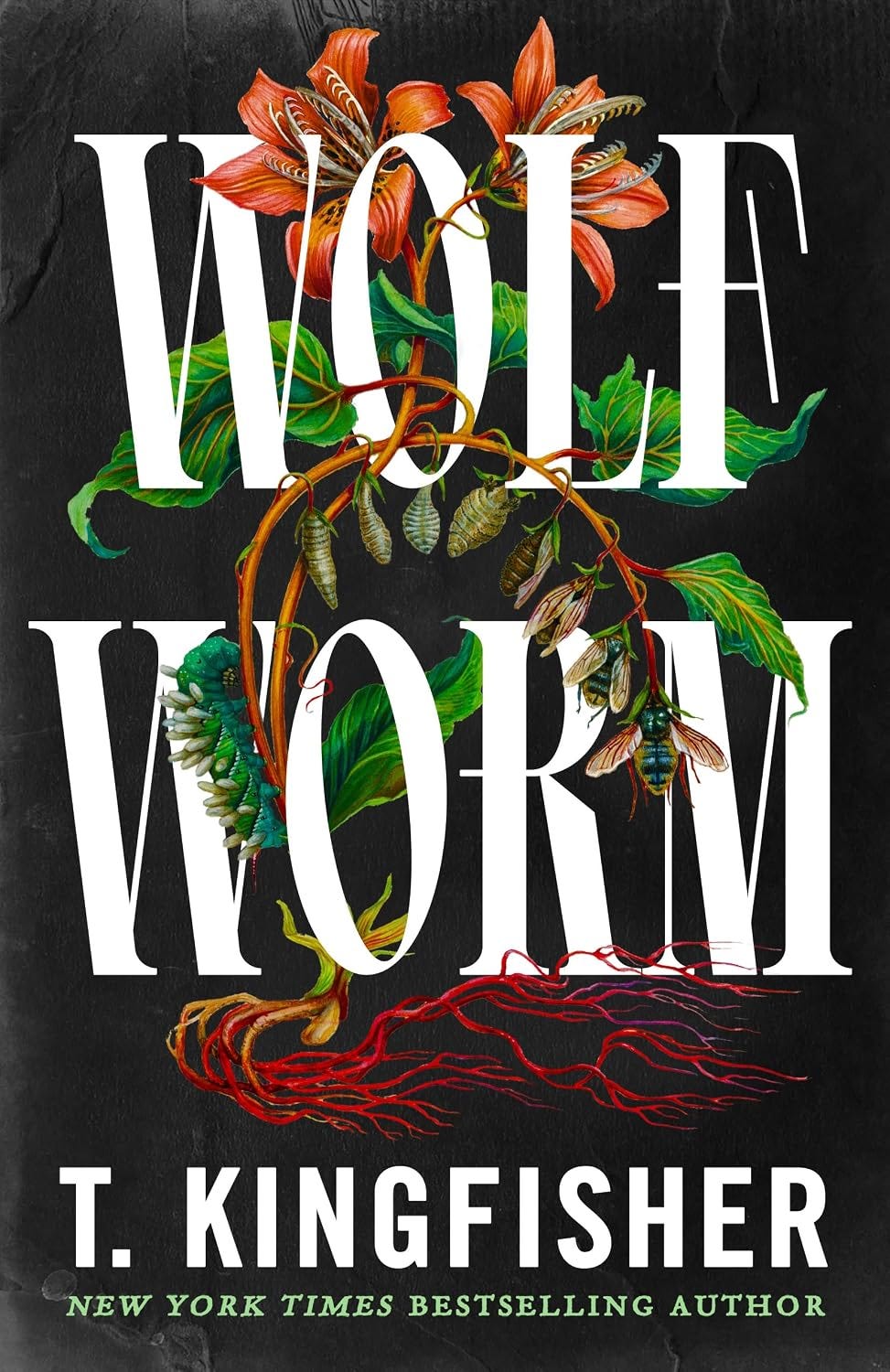
I know I’ve said this before, but I have yet to be disappointed in a book by T. Kingfisher. She is just one of those authors who knows how to put out banger after banger, and her new novel Wolf Worm is no exception. One part historical fiction, one part Southern Gothic, and one part body horror, this is the kind of book that, like the bot flies that are a central part of the story, crawls under your skin and refuses to go away. If there’s one horror author working today whose work I will always read and adore, it would be T. Kingfisher.
To begin with, there’s the fact that she makes a point of giving us heroines who are true badasses. Sonia Wilson, like many of Kingfisher’s other female protagonists, exists at the fringes of her society. The unmarried daughter of a naturalist, she is fortunate to have found employment in a remote manor, painting illustrations for a cantankerous entomologist named Dr. Halder, whose wife ran away with a man named Saul years before. Very soon, Sonia discovers that there’s something not quite right in the shed in the woods and that, in fact, he’s been keeping Saul a prisoner, his body a living lab for the doctor’s experiments with botflies.
It’s no exaggeration to say that I love Sonia, just like I’ve loved every one of Kingfisher’s other heroines. She’s snarky, she’s smart, and she’s not afraid to seek out the truth, even if doing so is likely to put her at significant risk. Indeed, the more the mystery deepens, and the more strange things happen around her, the more convinced she becomes that she has to do something. In fact, she’s the one who ends up rescuing Saul. Despite the fact that he’s a blood drinker and something not entirely–or perhaps not at all–human, she rightly sees that torturing him is wrong and takes action. I love her for that, and for the fact that, while she’s undeniably horrified by what she’s witnessing, she nevertheless has power and agency over her own life and that of others.
As Kingfisher explains in the author’s note at the end of the book, the central conceit in this book is the question: what would happen if a bot fly or some other parasite fed on a vampire? The answer, as it turns out, is quite terrifying. In essence, Saul has been serving as a perpetual host for the bot flies, who’ve essentially turned his body into their ever-replenishing smorgasbord, a fact made even more unsettling by the fact that botflies have subsequently been infecting small forest animals, taking over their nervous systems, and leading them to provide themselves as food for the captive Saul. The body horror in this novel is not for the faint of heart, and if in-depth descriptions of insect larvae feeding on flesh is something you can’t deal with, then this book probably isn’t for you (but then, you probably knew that anyway).
Narratively, Kingfisher is a master at building up a sense of dread. We know right from the jump that something isn’t quite right about this manor out in the middle of nowhere, first because, well, it’s a house in the South that’s far from any others and second because there are mentions of devilish beings that drink the blood of humans. With each unsettling thing that Sonia encounters, whether it’s an opossum that nearly beats itself to death to try to get into the house, a sinister story about a pair of twins who devoured humans, or the religious zealot who gives her a ride to the manor after she disembarks from the train, she comes closer to the beating heart of the mystery. And yet, beneath all of the scary things that happen, Kingfisher makes it clear that some of these beings–the blighted forest creatures, Saul, even the murderous twins–are worthy of pity. They are, at the end of the day, simply things that exist in a world that doesn’t understand them.
Kingfisher knows that one of the keys to effective horror is making sure you keep just the right amount of information out of reach. Thus, though we get some insight into just what kind of creature Saul is, she doesn’t really give too much explanation as to where his people come from and how long they’ve been preying on humans. For that matter, she doesn’t make it clear whether they’re of our species or something else entirely, perhaps something that evolved right alongside us to feast on us when we don’t expect it.
Like all of Kingfisher’s other books, Wolf Worm asks some pretty deep and thorny questions, and it denies us easy answers. Just as the bot flies feast on the flesh of Saul, Saul and his kind are known for their parasitic relationship with humans. While what Halder did to him is obviously repugnant–in no small part because Saul can speak and has a consciousness and all of the trappings of humanity, even if he isn’t actually human–the truth is that he is a creature whose very nature is such that they must feed on humans in order to survive. And yet, as he himself notes, he has done a lot of work to make sure he isn’t just bound to his nature and, though he is capable of terribly violent acts, he also seems to genuinely love Halder’s wife, Louisa.
While Wolf Worm sits nicely at the intersection of Southern Gothic and horror, I also appreciate the extent to which Kingfisher is also able to draw in elements of the historical novel. I particularly enjoyed the character of Mrs. Kent, a Black woman who has found her own little slice of happiness with a White man in the post-Reconstruction South. Kingfisher doesn’t hit us over the head with reminders of when this is taking place, but she does give us just enough period detail for us to really believe we’re reading about events that happened in a very specific time and place.
So, suffice it to say, T. Kingfisher’s track record of blowing me away with her storytelling prowess continues unabated. At this point, it’s hard to think of what she could do to turn me off. I can’t wait to see what unsettling fiction she has in store for us next!